KIếN THứC WEBSITE › UI/UX DESIGN

Usability test cơ bản: quy tắc 5 user, quy trình 5 bước và severity rating chuẩn

Usability test cơ bản: quy tắc 5 user, quy trình 5 bước và severity rating chuẩn

Usability test là phương pháp UX research kinh điển — quan sát user thật làm task trên product để identify pain point và severity rating. Bài này phân tích quy tắc 5 user của Nielsen, quy trình 5 bước trong 2-3 tuần, moderated vs unmoderated, severity rating 4 cấp, screener template, và 5 sai lầm phổ biến phá kết quả test.

Quy tắc 5 user của Nielsen — vì sao đủ và khi nào không đủ

Jakob Nielsen công bố nghiên cứu năm 1993, replicate lại 2023: test với 5 user phát hiện được 85% usability issue trong product. Test với 10 user lên 95%, 15 user gần 100% — diminishing return rõ ràng sau 5 user.

Lý do là issue lớn (catastrophic block task) lặp đi lặp lại ở mọi user. Sau 5 user, các issue mới phát hiện thường nhỏ hoặc edge case — không đáng investment thêm test cost.

Mức lý tưởng 5 user cho cost-effectiveness tốt nhất.

Bảng diminishing return theo số user

User count Issue identified Cost USD Recommendation
3 user ~65% 300-600 Quick directional, miss edge case
5 user ~85% 500-1.000 Mức lý tưởng recommended
10 user ~95% 1.000-2.000 Diminishing return
15 user ~100% 1.500-3.000 Overkill cho usability
20+ user ~100% 2.000+ Dùng cho quantitative research

Khi nào cần test thêm user

Quy tắc 5 user áp cho 1 persona đồng nhất. Nếu product có 2-3 persona khác biệt (vd buyer + seller marketplace), cần 5 user mỗi persona — tổng 10-15 user.

  • Persona đa dạng: B2B SaaS có admin + end user role — test 5 user mỗi role, mỗi role chạy task khác nhau.
  • Iterative test sau fix: sau khi fix issue từ round 1, chạy round 2 với 5 user mới để verify fix work mà không tạo issue mới.
  • Edge case critical: banking, healthcare có rủi ro cao thì thêm 3-5 user nữa để bắt edge case hiếm gặp nhưng impact lớn.

Khi nào KHÔNG cần usability test

Test không phải lúc nào cũng đúng method. 3 ngữ cảnh sau dùng method khác sẽ hiệu quả hơn — analytics quantitative hoặc survey.

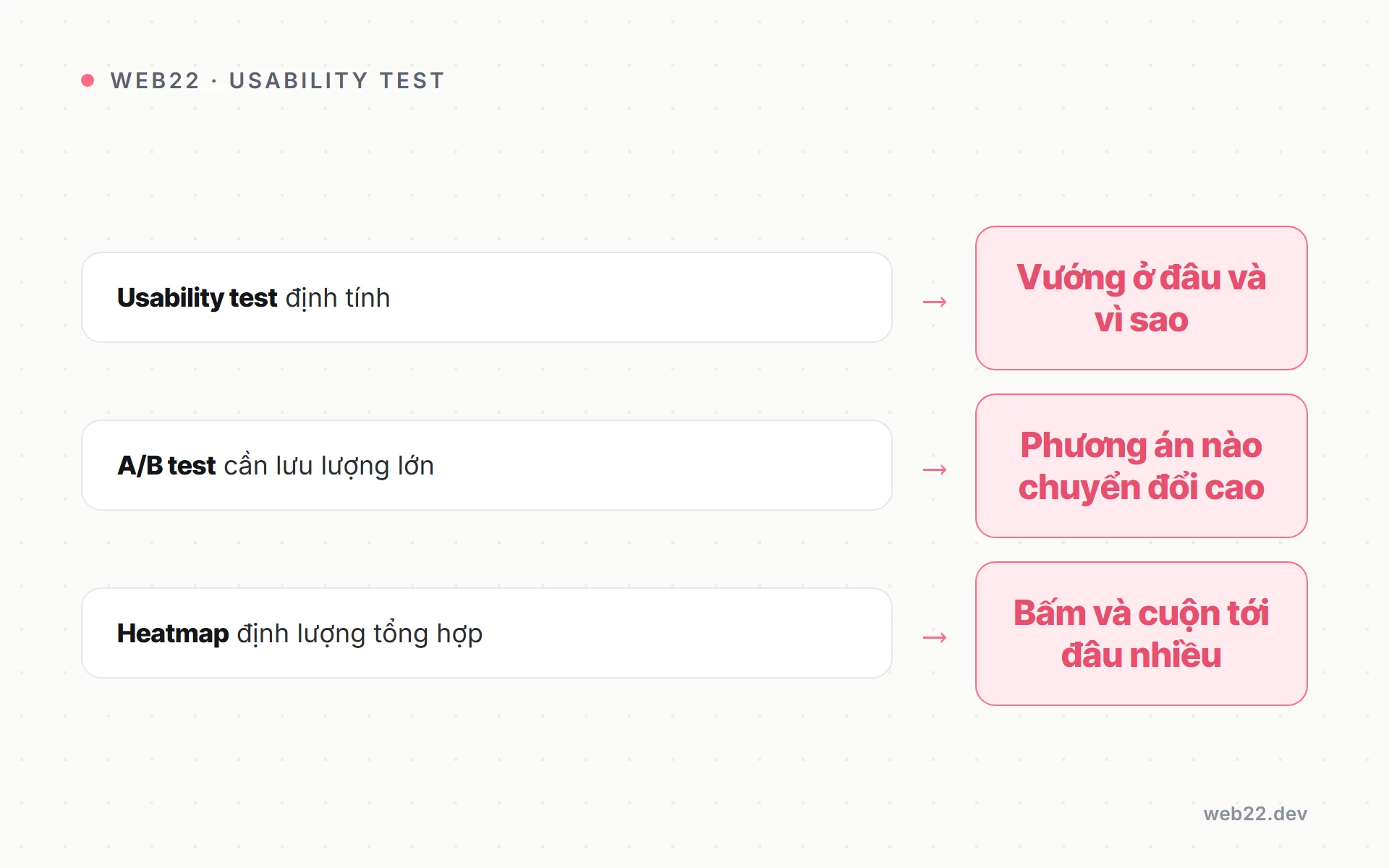
  • Cần data quantitative: đo conversion rate, drop-off phễu — A/B test hoặc analytics phù hợp hơn usability test.
  • Sample large statistical significance: nghiên cứu preference 1000+ user — survey hoặc card sorting tool cho data đủ.
  • Validate market fit ý tưởng: chưa có prototype thì interview hoặc concept test phù hợp hơn usability test.

Moderated vs unmoderated — chọn cái nào cho project

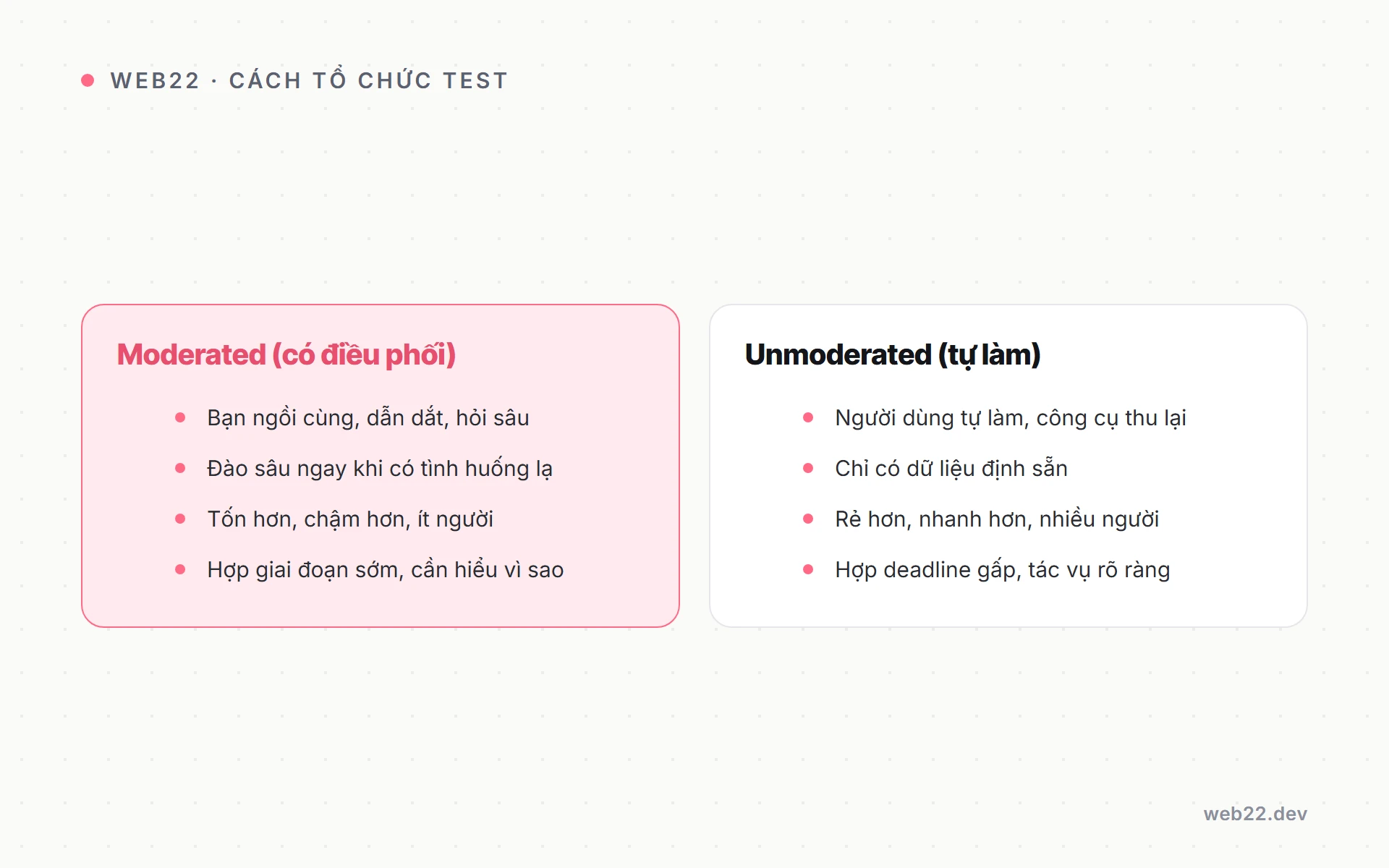
Hai phương pháp chính của usability test khác nhau ở presence của researcher. Trade-off rõ giữa depth insight (moderated) và scale + chi phí (unmoderated).

Hiểu trade-off chọn đúng method tiết kiệm 30-50% cost.

Moderated test — researcher facilitate live

Researcher present trong session, observe user làm task qua Zoom screen share. Cho phép probe deep “tại sao bạn tap đây”, capture facial expression và voice trong realtime.

  • Format chuẩn: Zoom call 45-60 phút 1-on-1, user share screen làm task think-aloud, researcher silent observe + ask theo dõi cuối session.
  • Pros: depth insight cao, capture nuance (hesitation, frustration), ask “tại sao” realtime — hiểu motivation behind action user.
  • Cons: đắt 80-200 USD/user, khó recruit vì user phải schedule cố định, bias risk nếu researcher lead user.
  • Cost benchmark: 5 user moderated 400-1.000 USD chưa kể researcher time. Cho VN: 1-3 triệu VND/user moderated.
  • Use case phù hợp: complex flow như checkout multi-step, onboarding mới, feature B2B SaaS chưa launch — cần hiểu sâu why before scale.

Unmoderated test — user self-test

User nhận task description qua email, làm task + record screen qua tool như UserTesting hoặc Maze. Researcher review video sau session, không present live.

  • Format chuẩn: 5-7 task script + scenario, user làm trong 30-45 phút độc lập, tool tự record screen + audio think-aloud.
  • Pros: rẻ 30-80 USD/user, scale 20-50 user/tuần dễ, user comfortable không observed nên hành vi tự nhiên hơn.
  • Cons: không probe deep được khi user confused, miss subtle issue (hesitation 2 giây không nhìn thấy qua video), user có thể skip task không rõ.
  • Cost benchmark: 5 user unmoderated 150-400 USD, recruit qua tool 1-3 ngày là xong. VN: 300-800K VND/user qua FB community.
  • Use case phù hợp: simple flow như signup, search, verify A/B test winner — đã có hypothesis rõ chỉ cần confirm.

Quy trình 5 bước run usability test — 2-3 tuần end-to-end

usability test cơ bản — Quy trình 5 bước run usability test — 2-3 tuần end-to-end
Sơ đồ minh hoạ — Quy trình 5 bước run usability test — 2-3 tuần end-to-end
Quy trình 5 bước run usability test — 2-3 tuần end-to-end
Sơ đồ minh hoạ — Quy trình 5 bước run usability test — 2-3 tuần end-to-end

Test discipline cao cho kết quả reliable. Skip step gây bias data, output không actionable.

5 bước dưới đây Web22 lock từ Nielsen Norman methodology áp cho project VN 2024-2026.

Bước 1 — Define test goal cụ thể

Test goal phải specific và measurable. “Verify UX checkout flow” quá vague. “Verify checkout flow new design có completion rate cao hơn old 20%” mới đúng — specific, measurable, có baseline so sánh.

Template goal: “Verify [feature/flow] với [persona] có [metric] đạt [threshold]”. Vd “Verify product filter mobile với buyer 25-35 tuổi có time-to-filter dưới 30 giây và completion rate trên 80%”.

Bước 2 — Write test script chuẩn

Script là yếu tố quyết định nhất. Bad script khiến user confused, data garbage.

Good script có 5-7 task realistic scenario, không lead user qua UI instruction.

  • Intro 5 phút: welcome + explain “test product không test you” + permission record + think-aloud instruction.
  • Pre-test 5 phút: demographic + tech comfort + frequency dùng product loại này — context cho phân tích sau.
  • Task 1-5 (30-40 phút): mỗi task có scenario realistic + success criteria rõ — vd “tìm iPhone dưới 30 triệu rồi add to cart”.
  • Post-test 10 phút: SUS-like rating 1-7, “task nào dễ nhất khó nhất”, “thiếu gì so với mong đợi”.

Bước 3 — Recruit user qua screener questionnaire

Recruit đúng persona quan trọng — test với wrong audience cho insight irrelevant. Screener 5-7 câu filter user trước test, eliminate poor fit.

  • Demographic match: tuổi, location, income — filter outlier khỏi target persona Web22 hoặc khách hàng.
  • Tech comfort: “online shopping mỗi tháng mấy lần” — filter quá hi hoặc lo so với target persona.
  • Product familiarity: “đã dùng app này chưa” — filter heavy user (bias do quen) hoặc never-user (irrelevant cho test).
  • Motivation: “tại sao tham gia test” — filter người chỉ muốn tiền, response quality kém.
  • Tech yêu cầu: có laptop, internet ổn định, microphone work — đảm bảo session không tech issue.

Bước 4 — Run test session

Moderated test trong 1 tuần với 5 user, mỗi session 45-60 phút. Unmoderated test trong 3-5 ngày với 10 user.

Record toàn bộ session để analyze sau.

Pre-flight checklist trước session: test camera + mic + screen share, reset browser cache, clear bookmark, đăng nhập test account riêng. Lỗi technical đầu session làm mất 10-15 phút quý giá.

Bước 5 — Analyze + severity rating

5 user × 45 phút = 225 phút video review. Analyze efficient bằng template note-taking + severity rating.

Tránh “mọi issue đều equal” — prioritize theo impact và frequency.

Output report 5 phần: executive summary 3 issue critical, method recap, findings sorted by severity 4-0, recommendations với action items, next test plan verify fixes work.

Severity rating chuẩn Nielsen — 5 cấp 0-4

Severity rating chuẩn Nielsen — 5 cấp 0-4
Sơ đồ minh hoạ — Severity rating chuẩn Nielsen — 5 cấp 0-4

Severity rating system của Nielsen Norman dùng từ 1994 đến nay vẫn standard cho UX industry. 5 cấp từ 0 (cosmetic) đến 4 (catastrophic block task).

Mỗi cấp map với action tiến độ cụ thể.

5 cấp severity và action map

  • 0 — Cosmetic: issue thẩm mỹ không impact task. Vd “submit button color hơi nhạt”.
  • Action: backlog, fix khi convenient.
  • 1 — Minor: low frequency, có easy workaround. Vd “label form hơi confusing nhưng tooltip giải thích”.
  • Action: fix trong quarter.
  • 2 — Moderate: some user affected, có workaround. Vd “filter chip ẩn dưới fold”.
  • Action: fix trong sprint hiện tại.
  • 3 — Major: most user hit, hard workaround. Vd “error message checkout không clear”.
  • Action: fix trong next release ngay.
  • 4 — Catastrophic: block task completion. Vd “cannot complete checkout mobile”.
  • Action: ship hotfix trong 24-48 giờ.

Rating objective dựa frequency + impact

Rating tránh subjective “tôi nghĩ issue này quan trọng”. Dùng 2 dimension đo objective: frequency (bao nhiêu user gặp) và impact (block task hay annoy nhẹ).

  • Frequency: 5/5 user gặp → severity tự động +1. 1/5 user gặp → có thể là edge case, không scale priority.
  • Impact: block task completion → severity 4. Annoy nhưng vẫn complete được → severity 1-2 tuỳ tần suất.
  • Workaround: có workaround dễ tìm → severity giảm 1 cấp. Không có workaround → severity giữ nguyên hoặc tăng.

Tool stack cho usability test 2026

Tool hệ sinh thái cho UX research mature 2026. Web22 dùng kết hợp 3 tool tuỳ moderated hay unmoderated, tuỳ budget khách hàng.

Tool cho moderated test

  • Zoom + screen share: free cho 40 phút, Pro 15 USD/tháng. Built-in record cloud — convenience cao.
  • Setup 5 phút là xong.
  • Lookback: 25-99 USD/tháng. Dedicated UX research tool — auto record screen + face camera + audio, marker timestamp cho key moment dễ revisit.
  • Google Meet + Loom: free kết hợp. Meet cho live call, Loom record session — phù hợp budget hạn chế hoặc startup early-stage.

Tool cho unmoderated test

  • UserTesting: 49-199 USD/test, panel US/EU mạnh. Có session video full record, transcript auto, sentiment analysis AI.
  • Phù hợp B2C global.
  • Maze: free tier 3 project, Pro 99 USD/tháng. Prototype-friendly với Figma, heatmap click + scroll, success rate tự đo.
  • Respondent.io: 50-150 USD/user, panel niche audience tốt. Phù hợp B2B SaaS recruit professional persona như doctor, engineer.

Tool cho recruit user VN

UserTesting và Respondent panel VN yếu — khó tìm user Vietnamese native cho test in-language. Web22 dùng 3 channel sau cho recruit VN.

  • Facebook community: post recruit trong group ngành phù hợp (vd group “Mom 30+” cho parenting app). Compensation 500K-1M VND/45 phút session.
  • Zalo group nội bộ khách hàng: nếu khách có existing user base, recruit từ subset đã đăng ký nhận research. ROI cao vì user familiar context.
  • UpWork freelancer VN: filter VN-based freelancer, post short-term gig 1-2 giờ test. Quality variable nên screen kỹ trước.

5 sai lầm phá kết quả usability test

Audit Web22 cho 15+ team UX research khách hàng 2024-2025 thấy 5 sai lầm sau lặp lại nhiều nhất. Đa số đến từ thiếu đào tạo methodology hoặc copy template không hiểu nguyên lý.

Sai lầm 1 — Lead user trong task script

“Click vào nút màu xanh ở góc trên” spoil hoàn toàn test. User không phải tự discovery UI — chỉ follow instruction.

Output không phản ánh real UX.

Fix: dùng scenario language “hoàn thành mua hàng” thay vì “tap nút Mua”. User tự discover button — đo được intuition UI có tốt không.

Sai lầm 2 — Recruit family hoặc colleague

Bias vì người quen đã familiar product hoặc muốn please researcher. Response không representative cho real user.

Insight unusable.

Fix: recruit external 100% qua UserTesting, Respondent, hoặc FB community ngoài network. Compensate đúng giá để response quality cao.

Sai lầm 3 — Skip rapport building intro

User nervous khi vào session lạ với researcher chưa quen. Response unnatural, hành vi defensive — không phản ánh real use.

Fix: 5 phút intro friendly, explain “test product không test you”, chat small talk weather hoặc cuối tuần. User relax mới think-aloud tự nhiên.

Sai lầm 4 — Severity rating subjective theo gut feeling

“Issue này quan trọng vì tôi nghĩ vậy” — rating bias theo preference researcher. Priority sai dẫn fix sai chỗ.

Fix: rating dựa frequency objective (bao nhiêu user gặp) + impact objective (block task hay annoy). Document rationale cho mỗi rating để team review.

Sai lầm 5 — Không theo dõi sau ship fix

Ship fix xong assume issue resolved. Không verify fix work — đôi khi fix tạo issue mới hoặc fix nhầm vào root cause khác.

Fix: round 2 test sau 4-6 tuần ship, focus vào flow đã fix với 5 user mới. Verify completion rate, time-to-task, error rate có cải thiện.

Câu hỏi thường gặp

UserTesting vs Respondent.io — tool nào tốt hơn cho startup VN?

UserTesting (49-199 USD/test) cho unmoderated với panel US/EU mạnh, record video full với transcript auto. Respondent.io (50-150 USD/user) cho moderated với panel niche professional tốt.

Cho startup VN target user Việt: cả 2 đều yếu panel VN — recruit qua FB community + Zalo group thay tool sẽ cho user representative hơn.

Kết hợp Web22 khuyến nghị: dùng tool global cho persona international (B2B SaaS phổ thông), recruit FB cho persona VN-specific (e-commerce, fintech VN). Compensate 500K-1M VND/session moderated VN giữ user quality cao.

Remote test qua Zoom có thay được in-person test không?

Có cho 95% case. Remote cheaper, dễ recruit, không tốn travel.

In-person chỉ cần khi: hardware specific như POS tablet, eye-tracking cần thiết bị riêng, sensitive context như healthcare cần observe body language full. Cho web app và ứng dụng di động thông thường — remote Zoom đủ depth insight.

Lưu ý: remote test mobile khó hơn web — user cầm phone không share screen được trực tiếp. Workaround: dùng tool như Lookback hoặc record qua phone camera kẹp khung, cost setup 1-2 triệu cho mỗi rig.

Pay user bao nhiêu cho 1 session 45 phút?

Global benchmark 30-80 USD/test unmoderated, 80-200 USD/test moderated. Cho VN: 300-800K VND unmoderated, 500K-1M VND moderated.

Avoid pay quá thấp dưới 200K — user quality drop, response qua loa cho xong session.

Persona specific có rate cao hơn. Doctor, engineer senior có thể 1.5-3M VND/session moderated.

Nhà sáng lập startup hoặc executive C-level 3-5M VND vì opportunity cost cao. Compensate đúng giá là yếu tố quyết định data quality.

Bao lâu nên run usability test 1 lần?

Trước major release verify flow new design — bắt buộc. Cho product mature: quarterly minimum, monthly cho early-stage iterate nhanh.

Combine với A/B test để complete picture — usability test cho qualitative why, A/B test cho quantitative which-wins.

Schedule chuẩn Web22: tuần 1 plan + recruit, tuần 2 run session 5 user, tuần 3 analyze + report. Tổng 3 tuần per round.

Có nghĩa quarterly cycle hợp với team capacity 1 researcher full-time hoặc 2-3 designer chia rotation.

Có thể skip usability test nếu đã làm A/B test?

Không hoàn toàn replace được. A/B test cho biết WHICH variant win nhưng không cho biết WHY win.

Hệ quả: ship variant winner không hiểu cơ chế, không generalize được cho feature tương lai. Lặp lại A/B test hoài không học gì.

Combine đúng: usability test trước để hypothesis why current flow fail, design variant fix root cause, A/B test verify variant fix scale ở 1000+ user. Mỗi method cover một câu hỏi khác — không thay thế lẫn nhau.

Tổng kết và bước tiếp theo

Usability test là UX research method có ROI cao nhất cho startup và mid-market — chỉ 5 user, 2-3 tuần là có actionable insight giảm friction conversion. Phối hợp với A/B test thiết kế cho quantitative validation và user journey mapping cho big-picture context.

Bài liên quan trong cluster UI/UX research:

Cần đội Web22 run usability test moderated 5 user end-to-end gồm script + recruit + session + analysis + action plan trong 2-3 tuần? Dịch vụ thiết kế UI/UX chuẩn doanh nghiệp tại Web22 — báo giá rõ theo phạm vi UX research, không phát sinh sau ký hợp đồng.