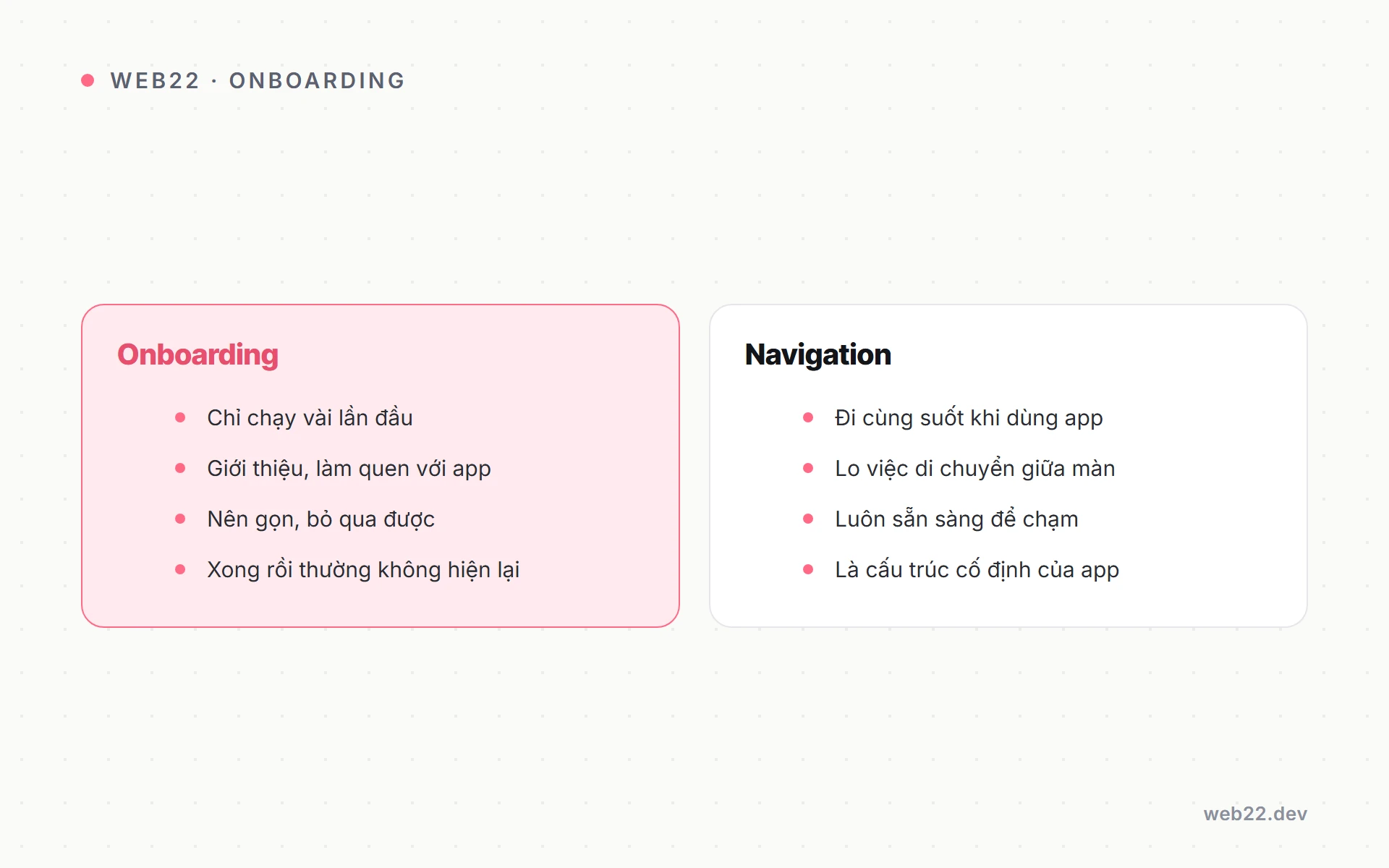
Onboarding ứng dụng di động quyết định retention D1, D7, D30. App có onboarding tốt giữ 25-40% user sau 7 ngày, đối thủ chỉ 5-15%.
Bài này giải thích 4 pattern (carousel tour, progressive form, coach-mark, empty state), value-first vs sign-up-first debate, A/B test setup chuẩn 2026, framework đo retention và 7 lỗi gây drop-off cao.
Vì sao onboarding quyết định retention
App nhận user qua install (organic search, ad). Sau install, 60-70% user uninstall trong 24 giờ nếu không thấy value rõ.
Onboarding 30-60s đầu tiên là moment “value revelation”.
Làm đúng = user understand benefit + complete first action = retain. Làm sai = uninstall immediately.
ROI onboarding optimization cao nhất trong stack UX mobile — đầu tư 2-4 tuần có thể double retention D7.
Bảng benchmark retention theo onboarding quality
| Onboarding quality | D1 retention | D7 retention | D30 retention |
|---|---|---|---|
| Excellent (best-in-class) | 50-60% | 25-35% | 10-15% |
| Good | 40-50% | 15-25% | 5-10% |
| Average | 30-40% | 10-15% | 3-5% |
| Poor | 20-30% | 5-10% | 1-3% |
Aha moment là gì
Aha moment là thời điểm user nhận ra giá trị cốt lõi của app — moment “à, app này solve problem của tôi”. Spotify aha = play song trong 30s.
Slack aha = send message trong 60s. Shopee aha = mua được item đầu trong 5 phút.
Onboarding tốt design để aha moment xảy ra trong 60s đầu tiên. Trễ hơn → user lose interest, churn.
Đo aha moment qua metric Activation Rate (định nghĩa sau).
4 pattern onboarding ứng dụng di động 2026
4 pattern phổ biến nhất 2026 cover hầu hết use case. Mỗi pattern có trade-off riêng, không có “best” universal.
Chọn pattern phù hợp app type và user persona.
Pattern 1 — Carousel tour 3-5 screen
Carousel tour là 3-5 screen full-screen trượt horizontal showing value proposition trước khi user vào app. Mỗi screen có illustration + headline ngắn 5-8 từ + sub-headline 1-2 dòng + dot indicator pagination.
Phù hợp app có concept mới user chưa quen (vd app meditation, fintech investment, web3). Skip button visible cho user experienced bypass tour.
Pattern thấy ở Headspace, Robinhood, Coinbase.
- Pros: communicate value rõ ràng, control narrative, dễ implement.
- Cons: nhiều user skip 70-80%, không deliver real value chỉ promise.
- Mức lý tưởng: 3-5 screen, mỗi screen 1 message clear, không multi-message overload.
Pattern 2 — Progressive form personalization
Progressive form là 2-4 screen hỏi user về interest, role, goal để personalize experience từ screen đầu. Vd app fitness hỏi “fitness goal: weight loss / muscle / endurance”, app news hỏi “interest: tech / business / sports”.
Phù hợp app có content/feature variable theo persona. Pattern thấy ở Duolingo (chọn language + goal), TikTok (chọn interest), Tinder (chọn preference).
Personalization sớm cho user feel “made for me”.
- Pros: high engagement immediately, data cho recommendation algorithm.
- Cons: friction cao, drop-off 20-30% nếu nhiều câu hỏi.
- Mức lý tưởng: 2-3 câu hỏi essential, mỗi câu <= 6 option, skip optional.
Pattern 3 — Coach-mark tooltip in-context
Coach-mark là tooltip overlay xuất hiện trên UI element thật khi user vào app lần đầu, giải thích “tap đây để X”. Khác carousel tour ở chỗ user thấy real UI thay vì illustration.
Phù hợp app có UI complex hoặc gesture không obvious (vd app design có gesture swipe-pinch, app game có touch kết hợp). Pattern thấy ở Instagram (stories), Figma (canvas tools), Procreate.
- Pros: contextual learning, user practice real interaction, không waste screen real estate cho tutorial separate.
- Cons: nếu nhiều tooltip → annoying, block UI. Khó dismiss intuitive.
- Mức lý tưởng: 2-4 tooltip cho key feature, dismiss bằng tap-outside hoặc explicit “Got it” button.
Pattern 4 — Empty state CTA
Empty state là khi user vào screen chưa có data (vd list rỗng vì chưa add item). Thay vì hiển thị screen trống, show helpful prompt với CTA “Add first item” + illustration encouraging.
Phù hợp mọi app có content/data user-generated. Pattern thấy ở Notion (workspace trống → “Create first page”), Todoist (task list trống → “Add first task”), Pinterest (board trống → “Save first pin”).
- Pros: không force user, contextual khi user ready engage, conversion add-first cao 40-60%.
- Cons: chỉ hiệu quả nếu user đã decide explore, không thay được initial value communication.
- Mức lý tưởng: illustration + 1 dòng motivating + CTA primary clear. Pattern minimal effective.
Value-first vs sign-up-first — debate kinh điển
Đây là decision quan trọng nhất khi thiết kế onboarding ứng dụng di động. 2 approach có philosophy đối lập, ROI khác biệt rõ ràng theo data 2024-2026.
Value-first approach
User explore app trước, sign-up sau khi đã thấy value. Pattern thấy ở Quora (browse content → sign-up khi save bookmark), Medium (đọc article → sign-up khi follow author), Pinterest (explore image → sign-up khi save pin).
Conversion install-to-signup cải thiện so sign-up-first. User commit emotional trước khi commit data — giảm friction psychological.
Data quality cũng tốt hơn vì user sign-up khi đã engaged.
Sign-up-first approach
User phải sign-up ngay sau install, không explore được app trước. Pattern legacy 2014-2018, vẫn dùng cho app cần authentication ngay (banking, healthcare, enterprise SaaS).
Conversion install-to-signup drop 50-70% so value-first vì user chưa thấy value. Nhưng data quality cao hơn — user sign-up qua barrier thì commit thực sự.
Phù hợp khi app không thể demo value mà không có account.
Khi nào chọn approach nào
- Value-first phù hợp: content app (news, social, e-commerce browse), tool app demo được mà không cần data user, app cần build interest trước commitment.
- Sign-up-first phù hợp: banking, healthcare, enterprise SaaS cần authentication ngay vì compliance, app có value chỉ unlock sau personalization data.
- Hybrid: demo value trong 30s (peek content, quick action) → sign-up gate sau khi user attempt save/bookmark/upgrade. Best of both worlds — pattern Spotify, YouTube Music.
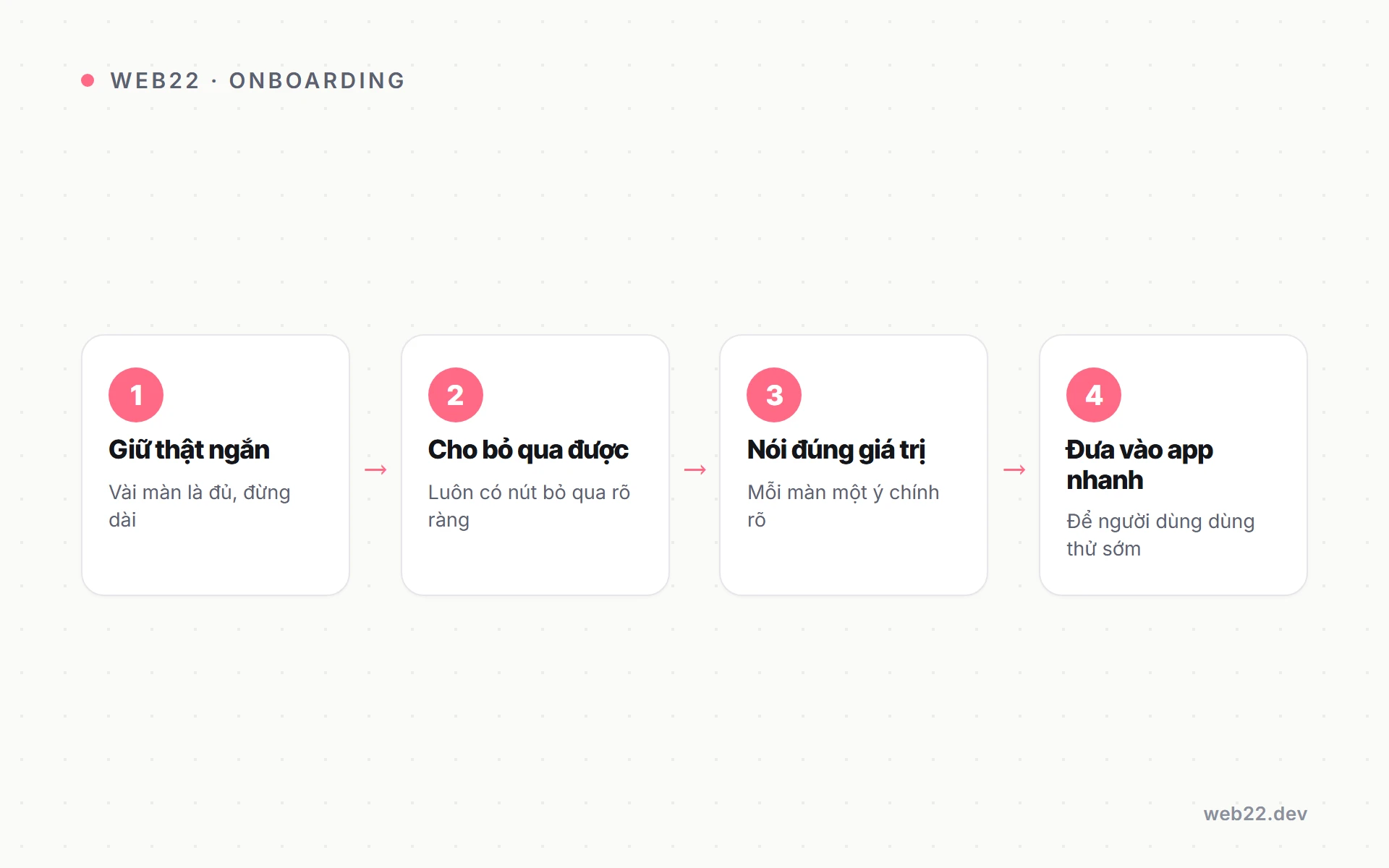
7 best practice onboarding ứng dụng di động 2024-2026
7 kỹ thuật impact cao nhất theo audit Web22 trên 25+ app mobile 2024-2025. Apply kết hợp 4-5 kỹ thuật trong 1 onboarding flow cho ROI tốt nhất.
Best practice 1 — Value-first không feature-tour
Show benefit (bạn save 30 phút/ngày) thay vì list feature (có 15 chức năng). User care về outcome, không tool.
Mỗi screen onboarding focus 1 outcome cụ thể với bằng chứng từ khách thật số liệu (1M user, 4.8 star, 30% productivity boost).
Best practice 2 — Aha moment trong 60s
Đưa user đến “first value experience” trong 60s. Spotify play song trong 30s.
Slack send message trong 60s. Strava log first activity trong 90s.
Đo qua metric Time-to-Value (TTV). Target < 60s.
Mỗi 30s delay TTV → retention D7 drop 5-10%. Critical metric cho onboarding optimization.
Best practice 3 — Progressive disclosure
Show feature gradually, không 10 screen tutorial upfront. Reveal khi user ready — vd advanced filter shop chỉ hiện sau khi user browse 5+ product.
Pattern này dựa trên Hick’s Law (nhiều choice → quyết định chậm). Onboarding minimal reveal giảm cognitive load 40-60%, completion rate cao hơn.
Best practice 4 — Personalization sớm
Hỏi 2-3 câu (interest, role, goal) → customize experience từ screen đầu. User feel “made for me” — engagement immediately cao hơn.
Câu hỏi essential: industry/role (B2B SaaS), interest (e-commerce), goal (productivity). Quá nhiều câu = user bored, drop-off.
Mức lý tưởng 2-3 câu.
Best practice 5 — Skip option visible
User experienced không bị force qua tutorial. “Skip intro” button visible top-right, không hidden. Respect user time = trust user judgment.
Force tutorial khiến user power feel disrespected — drop-off cao 30-50%. Skip không hại nếu default flow tốt — user new vẫn follow default, user expert skip không impact retention.
Best practice 6 — Empty state guidance
Khi user chưa có data (empty list), show helpful prompt với CTA “Add first item” thay screen trống. Illustration encouraging + 1 dòng motivating + CTA primary clear.
Empty state design tốt convert add-first 40-60%. Pattern minimal effective — không cần feature dài, chỉ cần encourage action đầu tiên.
Best practice 7 — Celebrate first success
Confetti animation, badge “First X done”, micro-interaction reward. Dopamine hit = user come back.
Pattern thấy ở Duolingo (streak fire), Strava (PR celebration), Headspace (mốc badge).
Celebrate đúng moment quan trọng — first action, first mốc, first streak. Tránh celebrate everything → cheapen reward, user numb phản hồi.
5 anti-pattern destroy retention
Audit Web22 cho 25+ app mobile 2024-2025 thấy 5 anti-pattern sau lặp lại nhiều nhất. Fix 1 trong 5 này thường cải thiện retention D7 từ 15-30% relative.
Anti-pattern 1 — Wall of features 10+ screen tutorial
10+ screen carousel tour upfront, user overwhelmed, skip hoặc uninstall. Drop-off ngay screen 3-4 lên 50-70%.
Fix: max 3-5 screen, focus value không feature. Mỗi screen 1 message clear, không multi-message overload.
Skip visible.
Anti-pattern 2 — Force registration trước value
User chưa thấy value đã bắt đăng ký. 60% drop off ngay sign-up screen.
Friction cao nhất trong toàn flow onboarding.
Fix: explore first, register sau khi see value (pattern Quora, Medium). Hoặc hybrid demo 30s rồi gate sign-up khi user attempt save/upgrade.
Anti-pattern 3 — Permission dump
Request notification + location + contact + camera một lần. iOS reject hard 70-80%, user uncomfortable với app aggressive permission.
Fix: request permission Just-In-Time khi cần — vd notification permission ask sau khi user complete first action (“Track order via notifications?”). Conversion grant cải thiện so ask immediately.
Anti-pattern 4 — Tutorial tooltip everywhere
Mỗi button có tooltip giải thích. Annoying, block UI, user không thể explore tự do.
Pattern này thường gặp ở app B2B over-engineering onboarding.
Fix: in-context hint khi user struggle (after 10s idle). Hoặc 2-4 coach-mark cho key feature only, dismiss bằng tap-outside hoặc explicit “Got it”.
Anti-pattern 5 — Generic onboarding cho mọi user
Doctor và student thấy cùng screens. Engagement drop vì content không relevant cho persona specific.
Lost opportunity personalization.
Fix: ask 1-2 question lúc start, branch experience theo answer. Vd app fitness ask “goal: lose weight / build muscle / endurance” → 3 flow khác nhau hoàn toàn.
Framework đo onboarding effectiveness — 5 metric
Onboarding optimization data-driven cần metric đúng. Track 5 metric qua Mixpanel, Amplitude, Firebase hoặc PostHog.
Mỗi metric reveal khía cạnh khác — không thay thế lẫn nhau.
Metric 1 — Activation Rate
Định nghĩa: % user complete “aha moment” within 24h. Formula: count(users completed first key action) / count(installs).
Target 30-50% là good, 50%+ là excellent.
“Key action” tuỳ app — send first message (Slack), play song (Spotify), buy first item (e-commerce), log first activity (Strava). Mỗi app cần define key action specific cho domain mình.
Metric 2 — Time to Value (TTV)
Định nghĩa: seconds từ install đến first value. Formula: median(timestamp_first_value – timestamp_install).
Target < 60s. Lower TTV = higher activation = higher retention.
Đo qua event tracking — log timestamp install (app open first time) và timestamp first value (key action). Mixpanel/Amplitude phễu report tính median tự động.
Metric 3 — Onboarding Completion Rate
Định nghĩa: % user complete tutorial flow. Formula: count(completed onboarding) / count(started onboarding).
Target 70-85% là good.
Drop-off per step identifies friction. Vd step 3 (sign-up form) drop 40% → friction lớn → cần simplify form.
Step-by-step analysis cho actionable insight cụ thể.
Metric 4 — Step Drop-off
Định nghĩa: % user lose at each step. Track phễu: step1 → step2 → step3 → …
Target < 15% per step.
Step có > 30% drop cần redesign required. Hypothesis cho redesign — friction (too many field), confusion (unclear instruction), bug (technical issue).
Verify hypothesis qua user research hoặc session recording.
Metric 5 — D1 / D7 / D30 Retention
Định nghĩa: % user open app on day 1/7/30 after install. Industry benchmark ứng dụng di động 2026:
- D1: 30-50% good, 50%+ excellent.
- D7: 15-25% good, 25%+ excellent.
- D30: 5-15% good, 15%+ excellent.
Retention curve shape quan trọng hơn point — flat curve (mất user nhanh sau D7) khác smile curve (mất nhanh rồi stable). Smile curve dấu hiệu product-market fit tốt.
Tool implementation
- Mixpanel: 25-100 USD/tháng start. Event tracking + phễu analysis + cohort retention chart built-in.
- Amplitude: 49-200 USD/tháng. Similar Mixpanel với behavioral cohort mạnh hơn cho B2B.
- Firebase Analytics: free, basic. Đủ cho startup early-stage chưa cần advanced segmentation.
- PostHog: free open-source self-host. Phù hợp privacy-conscious team hoặc EU GDPR strict.
A/B test onboarding mobile — setup chuẩn 2026
Onboarding optimization iterative. Phễu analysis identify drop-off step → hypothesis fix → A/B test variant → measure impact → ship winner.
Cycle 2-4 tuần per round.
Workflow A/B test 5 bước
- Phễu analysis: Mixpanel/Amplitude phễu report show drop-off mỗi step. Identify worst step có drop > 30%.
- User research qualitative: 5-10 user interview hoặc session recording → hiểu why drop-off. Hypothesis cho fix cụ thể.
- Design variant: A/B variant cụ thể. Vd current step 3 = sign-up form 8 field, variant = 3 field essential only.
- A/B test split 50/50: run 2 tuần minimum để có sample đủ statistical significance. Tool Firebase A/B Testing, Optimizely Mobile, hoặc Apptimize.
- Ship winner: implement winner cho 100% user. Monitor 4 tuần verify positive impact stable, không novelty effect.
Tool A/B test mobile
- Firebase A/B Testing: free cho iOS/Android. Combine với Remote Config để variant không cần app update.
- Phù hợp 80% startup.
- Optimizely Mobile: paid, advanced. Có visual editor cho non-dev, segmentation phức tạp.
- Apptimize: paid, advanced. Mạnh feature flag + A/B test kết hợp cho enterprise.
Sample size cho statistical significance
Sample size tối thiểu phụ thuộc baseline rate và expected lift. Vd baseline activation 30%, expected lift 5 percentage points (35%), need 1500-2000 user mỗi variant cho 95% confidence.
Dùng calculator như Optimizely Sample Size Calculator. Tránh peek early — chỉ measure khi đạt sample size planned, tránh false positive do random variance ngắn hạn.
Anti-pattern A/B test
- Test quá nhiều variant cùng lúc: 5+ variant chia traffic loãng, không variant nào đạt significance. Sửa: test 2 variant (A vs B) hoặc 3 (A vs B vs C) max.
- Stop test sớm khi thấy “winner”: early peek dễ false positive. Sửa: lock sample size + duration từ đầu, chỉ measure cuối.
- Test cosmetic không impact metric: đổi màu button không ảnh hưởng activation rate. Sửa: chỉ test thay đổi có hypothesis impact KPI cụ thể.
Câu hỏi thường gặp
Onboarding nên skip-able hay forced?
Skip-able là default tốt nhất. Forced onboarding làm user power feel disrespected, drop-off cao 30-50%.
Skip option visible cho user experienced — respect user time = trust user judgment.
Default flow cho new user nhưng cho phép skip. User new vẫn follow default, user expert skip không impact retention.
Win-win cho cả 2 persona.
Bao nhiêu screen onboarding tối ưu?
3-5 screen là mức lý tưởng. < 3 thiếu value communication. > 5 user overwhelmed, drop-off cao. Mỗi screen 1 message clear, không multi-message overload.
Pattern Web22 áp cho khách: screen 1 hook value, screen 2-3 demonstrate feature, screen 4 personalization (optional), screen 5 sign-up hoặc CTA primary. Test variant 3 vs 5 screen để verify cho app cụ thể.
Push notification permission khi nào ask?
Sau “first value moment”, không lúc install. Vd shop app: ask sau khi user complete first purchase “Track order via notifications?”.
Hoặc news app: ask sau khi user follow first topic.
Conversion permission grant cải thiện so ask immediately. iOS đặc biệt aggressive với app request permission upfront — system suggest user reject. Just-In-Time pattern win mọi metric.
Personalization onboarding cần data nào?
2-3 câu hỏi essential. Industry/role cho B2B SaaS.
Interest cho e-commerce hoặc content app. Goal cho productivity hoặc fitness app.
Mỗi câu <= 6 option để decision nhanh.
Quá nhiều câu = user bored, drop-off. Skip optional cho user không muốn share data.
Branch experience theo answer — vd app fitness goal “lose weight” → flow khác “build muscle”.
Tool A/B test mobile onboarding nào tốt?
Firebase A/B Testing free cho iOS/Android. Combine Remote Config để variant không cần app update — flexibility cao.
Phù hợp 80% startup early-stage.
Apptimize, Optimizely Mobile paid nhưng có visual editor cho non-dev và segmentation phức tạp. Phù hợp enterprise với team product manager non-technical.
Cho startup VN: Firebase đủ.
Carousel tour có outdated 2026 không?
Không outdated nhưng cần dùng đúng context. Carousel tour vẫn hiệu quả cho app có concept mới user chưa quen (web3, fintech, meditation).
Outdated khi dùng cho app concept thông dụng (e-commerce, social) — user đã quen, tour waste time.
Pattern hybrid: carousel 2-3 screen value proposition + skip visible, sau đó vào real UI với coach-mark cho gesture-specific. Best of both worlds — communicate value + practice real interaction.
Onboarding cho app B2B SaaS khác consumer thế nào?
B2B SaaS có 2 onboarding layer. Layer 1 cho admin (setup workspace, invite team, integrate tool).
Layer 2 cho end user (member team mới được invite). 2 layer cần flow khác hoàn toàn.
Admin onboarding phức tạp hơn — 5-10 step, có thể spread qua nhiều session. End user onboarding ngắn — 2-3 step focus task chính trong workspace đã setup.
Personalization cao theo role.
Tổng kết và bước tiếp theo
Onboarding ứng dụng di động quyết định 60-80% retention D7. 4 pattern (carousel, progressive form, coach-mark, empty state) cover hầu hết use case.
Value-first thường win sign-up-first cho consumer app.
Aha moment trong 60s + skip option visible + permission Just-In-Time là 3 trụ cột best practice. A/B test framework với 5 metric (Activation, TTV, Completion, Drop-off, Retention) cho data-driven optimization.
Bài liên quan trong cluster UI/UX mobile:
- Navigation ứng dụng di động — 5 pattern và khi nào dùng — context navigation cho onboarding flow đầu.
- Touch target tối thiểu — iOS 44pt + Android 48dp — tap area cho CTA onboarding screen.
- Bottom sheet mobile — 3 biến thể và snap point — pattern overlay cho permission prompt và confirm action.
- Usability test cơ bản — 5 user và severity rating — verify onboarding flow trước A/B test.
Web22 design + audit + optimize onboarding ứng dụng di động turnkey cho startup, e-commerce và B2B SaaS VN — từ wireframe carousel/progressive form Figma, implement React Native với personalization branching, setup analytics Mixpanel/Amplitude, đến A/B test framework cycle 2-4 tuần. Dịch vụ thiết kế UI/UX chuẩn doanh nghiệp tại Web22 — phạm vi chi tiết và tiến độ 3-6 tuần cho mobile UX optimization end-to-end.