KIếN THứC WEBSITE › UI/UX DESIGN

User journey mapping: 5 giai đoạn, 6 thành phần và quy trình build 1-2 tuần

User journey mapping: 5 giai đoạn, 6 thành phần và quy trình build 1-2 tuần

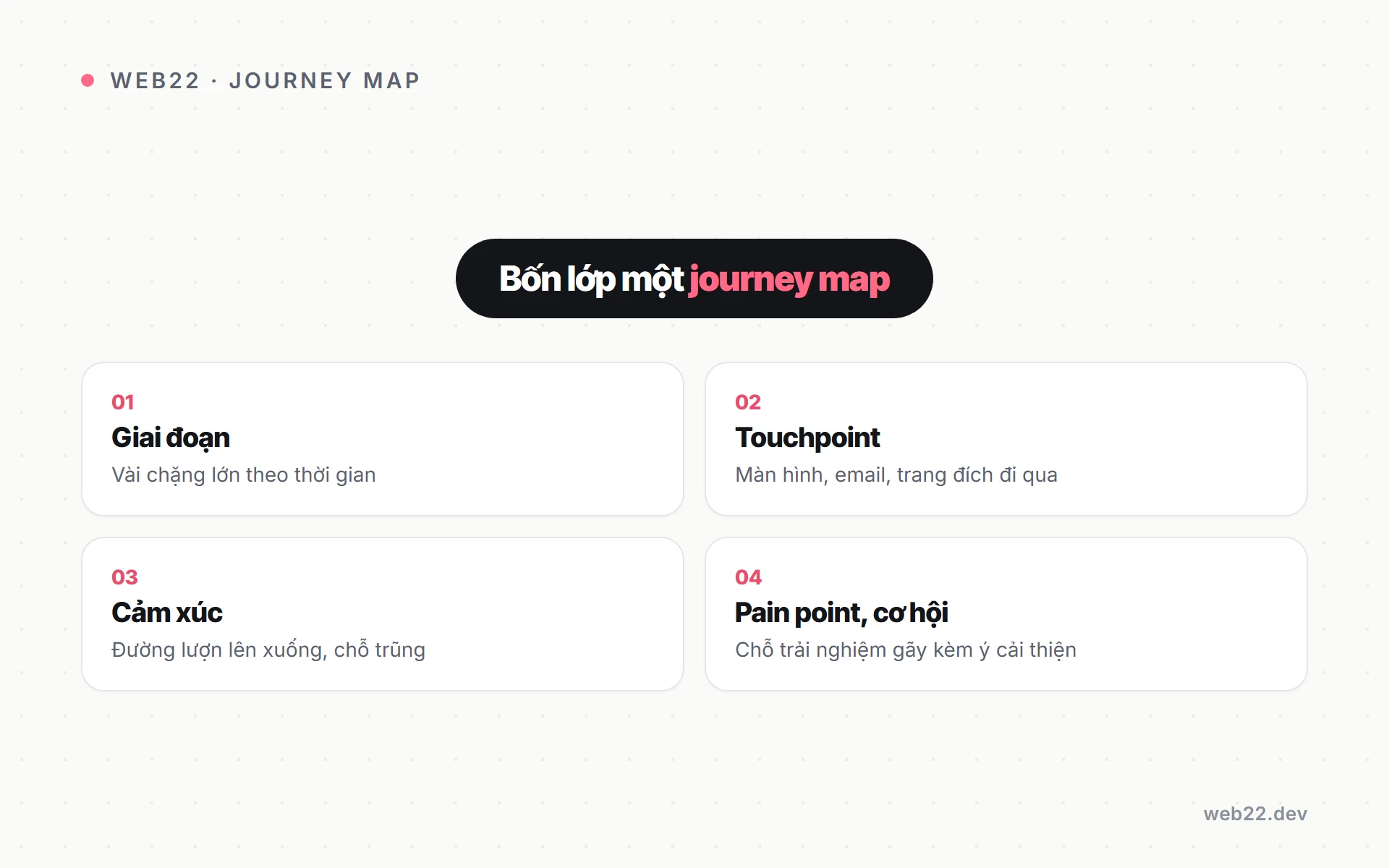
User journey mapping là kỹ thuật visualize trải nghiệm khách qua mọi điểm chạm từ awareness đến retention dưới dạng tiến độ 5-7 giai đoạn. Output gồm 6 thành phần: stage, action, điểm chạm, emotion curve, pain point, opportunity.

Setup mất 1-2 tuần kết hợp interview 5-8 khách hàng với analytics data và workshop nội bộ. Bài này hướng dẫn quy trình 5 bước, template spreadsheet, công cụ FigJam/Miro/UXPressia và 5 trap dễ mắc.

Vì sao team product cần journey map

Journey map giải quyết bài toán team product nhìn sản phẩm theo perspective dev/designer (feature-by-feature), không phải perspective user (problem-by-problem). Map visualize toàn bộ trải nghiệm tiến độ thay vì cắt từng màn hình.

User tìm shop, click ad, research, checkout, unboxing, support — mỗi bước trong chuỗi là một điểm chạm có thể đo emotion. Identify moment pain hoặc delight để priority backlog feature fix theo impact thực tế.

4 mục tiêu chính của journey map

Mục tiêu Output Dùng quyết định gì
Discover pain point List 10-20 friction point Priority backlog feature fix
Find delight moment 2-3 moment wow Marketing message focus
Map điểm chạm cross-channel Diagram 5-7 stage Resource allocation team
Align team understanding Shared mental model Stakeholder buy-in

Khác biệt giữa journey map và user persona

Persona mô tả “ai là user” với 6 khối thông tin demographic và goal. Journey map mô tả “user đi qua bước nào” theo tiến độ.

Hai sản phẩm bàn giao bổ sung nhau — journey map thường build cho 1 persona cụ thể, không generic cho mọi đối tượng.

  • Persona: chân dung tĩnh, focus character + motivation, output 1 trang A4 mô tả user.
  • Journey map: hành trình động theo thời gian, focus action + emotion, output diagram nhiều cột 5-7 stage.
  • Quan hệ workflow: Web22 thường gộp 2 sản phẩm bàn giao này trong cùng 1 sprint research vì share interview source 5-8 khách hàng.

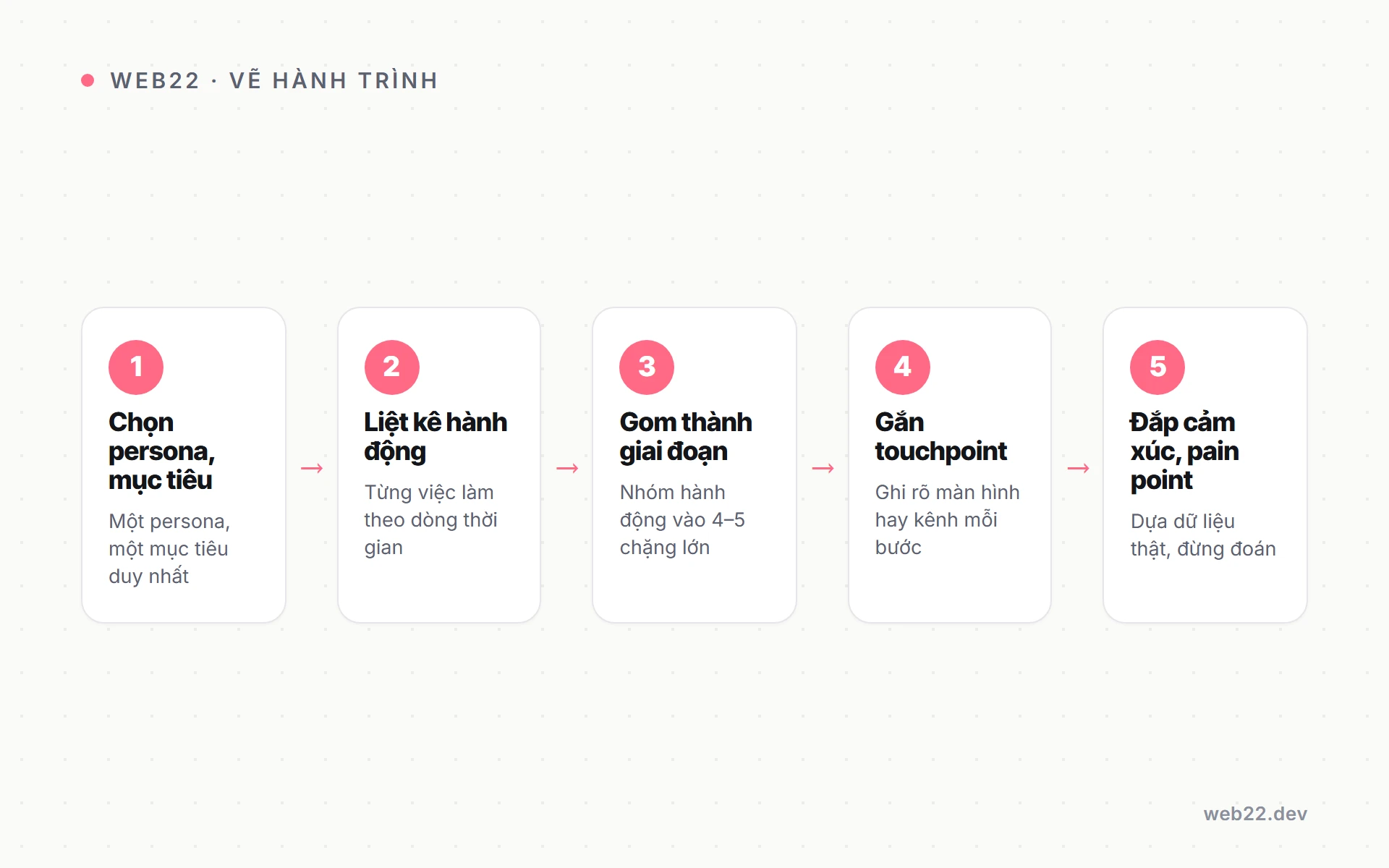
Quy trình 5 bước build journey map

user journey mapping — Quy trình 5 bước build journey map
Sơ đồ minh hoạ — Quy trình 5 bước build journey map
Quy trình 5 bước build journey map
Sơ đồ minh hoạ — Quy trình 5 bước build journey map

Journey map không phải workshop 1 ngày mà process 1-2 tuần với research thật. Skip research khiến map dựa trên assumption, không reflect reality và sẽ outdated trong 3-6 tháng.

Bước 1 — Define persona target

Chọn 1-2 user persona chính làm chủ thể của journey. Reference user persona là gì để có chân dung detail demographic + behavior + goal trước khi map hành trình.

Tránh build map generic cho “khách hàng nói chung” — sẽ dẫn tới insight chung chung không actionable. Mỗi persona có journey khác nhau, đừng cố gộp vào 1 map duy nhất.

Bước 2 — Identify stage chính

5-7 stage chính cho hành trình customer. Pattern phổ biến cho e-commerce: Awareness, Consideration, Decision, Purchase, Onboarding, Use, Retention.

Cho SaaS B2B thường thêm Evaluation và Renewal.

Không nên quá 7 stage vì map sẽ crowded và khó đọc. Stage tương tự nên merge — vd “Compare brand” và “Read review” có thể gộp thành “Consideration” duy nhất.

Bước 3 — Research điểm chạm và action

Mỗi stage user làm gì, qua channel nào, điểm chạm nào. Combine 3 nguồn data: customer interview 5-8 user (qualitative depth), analytics review (quantitative verify), survey (validate scale).

Interview là nguồn chính, analytics chỉ verify. User say 1 thứ và behavior log show thứ khác — cross-check qua GA4 user flow, Hotjar session recording, phễu drop-off rate, time on page per stage.

Bước 4 — Map emotion curve với evidence

Emotion line là phần powerful nhất của map nhưng dễ subjective. Approach data-driven: emotion score 1-10 dựa từ multiple source — interview quote, survey rating, sentiment analysis support ticket.

  1. Mỗi stage list 3-5 specific moment user trải qua.
  2. Mỗi moment rate emotion 1-10 dựa research data có quote support cụ thể.
  3. Plot lên line chart để visualize emotional rollercoaster end-to-end.
  4. Identify “valley of despair” — vùng low emotion là priority fix top trong sprint sau.
  5. Identify “peak of delight” — moment để amplify trong marketing message.

Bước 5 — Workshop nội bộ và iterate

Present draft map với team product + marketing + sales trong buổi 90 phút. Cho team challenge từng stage: “Bạn nghĩ user thực sự cảm thấy thế nào ở bước này, dựa trên kinh nghiệm tiếp xúc?”.

Refine theo phản hồi nhưng không capitulate ngay — push back khi team nói trái với evidence từ interview. Final sản phẩm bàn giao: visual map cộng action item prioritized có owner và ETA.

6 thành phần của journey map đầy đủ

6 thành phần của journey map đầy đủ

Một template journey map có thể trông đẹp với màu sắc và icon, nhưng giá trị thực nằm ở 6 thành phần actionable. Thiếu thành phần nào map đó sẽ không drive change được trong sprint planning thực tế.

Thành phần 1-2 — Stage và Action

Stage là cột header chia tiến độ thành 5-7 giai đoạn. Action là hành động cụ thể user làm trong từng stage — không generic kiểu “tìm hiểu” mà phải cụ thể “search Google 3 keyword, đọc 5 review”.

Thành phần 3 — Điểm chạm cross-channel

Channel nào user gặp brand trong từng stage. Facebook ad, Google search, Zalo OA, email, in-app notification, support chat, unboxing physical.

Điểm chạm quyết định resource allocation team marketing và CX.

Thành phần 4 — Emotion curve

Đường cong cảm xúc 1-10 qua từng stage. Visualize rollercoaster: curious lúc awareness, anxious lúc decision (sợ lừa giá), stressful lúc checkout, excited lúc unboxing, loyal lúc retention.

Thành phần 5 — Pain point cụ thể

Cản trở user gặp trong từng stage. Pain point phải có quote thực từ interview hoặc data analytics — “checkout 4 step làm 38% bỏ giỏ” cụ thể hơn “checkout phức tạp”.

Thành phần 6 — Opportunity actionable

Mỗi pain point cần 1-2 opportunity tương ứng. Opportunity là feature, content, hoặc process có thể fix pain — input thẳng vào sprint backlog với owner và ETA.

Template 6 thành phần dạng spreadsheet

# Journey Map Template — 5 row × 7 stage cho e-commerce

              Awareness  Consideration  Decision   Purchase   Onboarding  Use       Retention
─────────────────────────────────────────────────────────────────────────────────────────────
Actions       See ad     Compare brand  Read       Add cart   Receive    Daily use  Renew sub
              Search     Check spec     review     Pay        item       Browse     Refer
─────────────────────────────────────────────────────────────────────────────────────────────
Điểm chạm    FB ad      Google         Shop blog  Checkout   Email      Mobile     Email
              IG ad      review site    page       Email      Unboxing   Web app    In-app
─────────────────────────────────────────────────────────────────────────────────────────────
Emotion       Curious    Uncertain      Anxious    Stressful  Excited    Confident  Loyal
              (4/10)     (5/10)         (3/10)     (4/10)     (8/10)     (8/10)     (7/10)
─────────────────────────────────────────────────────────────────────────────────────────────
Pain Point    Ad không   Khó compare    Thiếu      Checkout   Setup      Feature    Quên renew
              relevant   brand          trust      4 step     confused   unclear    Support chậm
─────────────────────────────────────────────────────────────────────────────────────────────
Opportunity   Better     Comparison     Add review Single     Better     Tooltip    Loyalty
              targeting  table          warranty   page       onboarding feature    program

Research methodology cho journey map

Journey map quality phụ thuộc research quality. 3 phương pháp combine: customer interview (qualitative depth), analytics review (quantitative verify), survey (validate scale ở user base lớn).

Customer interview 5-8 user — qualitative depth

  • Recruit mix: 2-3 power user loyal nhiều năm, 2-3 new user signup dưới 3 tháng, 2 churned user huỷ subscription — cover toàn bộ lifecycle.
  • Format: 45-60 phút Zoom call, record có consent, transcript qua Otter.ai hoặc Microsoft Word. Open-ended question, không lead user về phía sản phẩm.
  • Question pattern: “Walk me through last time you used [product]” — story-based response value cao hơn ask preference. Probe vào emotion và frustration cụ thể.
  • Output: transcript cộng 10-20 quote highlight per user. Synthesize thành theme common qua affinity diagram FigJam.

Analytics review — quantitative verify

Customer say 1 thứ và behavior log show thứ khác là tình huống thường gặp. Cross-check insight qualitative với data từ GA4 user flow report, Hotjar session recording (xem heatmap cho web), phễu drop-off rate, time on page.

Survey — validate scale

Interview cho insight depth nhưng sample nhỏ (5-8 user). Survey cho biết insight đó có generalize cho user base lớn hơn không — gửi 200-500 user, thu 30-50 response trong 1-2 tuần.

Convert map thành action item prioritized

Map có giá trị khi convert thành action item. Prioritize theo Impact và Effort matrix: high impact cộng low effort là quick win ship trước, high impact cộng high effort vào roadmap quarterly.

Action item template với prioritization

# Action item extracted từ journey map

ID | Pain point                    | Impact | Effort | Priority | Owner    | ETA
───┼───────────────────────────────┼────────┼────────┼──────────┼──────────┼──────
1  | Checkout 4 step quá dài       | 9/10   | 5/10   | P0       | Frontend | 2 tuần
2  | Onboarding setup confusing    | 8/10   | 4/10   | P0       | Product  | 3 tuần
3  | Email confirm chậm 5 phút     | 6/10   | 2/10   | P1       | Backend  | 1 tuần
4  | Comparison table missing      | 7/10   | 3/10   | P0       | Content  | 1 tuần
5  | Ứng dụng di động slow load          | 8/10   | 8/10   | P1       | Mobile   | Q2 roadmap
6  | Loyalty program unclear       | 5/10   | 6/10   | P2       | Marketing| Q3 roadmap

# Priority logic:
# P0 = High impact + Low/Medium effort (ship 2-4 tuần)
# P1 = High impact + High effort (next quarter)
# P2 = Medium impact + Any effort (backlog)
# P3 = Low impact (defer)

Workshop output bắt buộc

  • Tối thiểu 10 action item: map có 6-8 pain point thường sinh 10-15 action item — dưới 10 nghĩa là chưa khai thác hết insight từ research.
  • Owner và ETA cho mỗi item: không có owner thì item sẽ orphan, không ship — assign rõ frontend, backend, product, marketing.
  • Review quarterly: mỗi quý quay lại đánh giá item nào đã ship, item nào còn tồn — update priority theo data mới.

Công cụ build journey map 2026

Tool nào cũng được, miễn dễ chia sẻ và update khi research mới. Dưới đây là 4 nhóm tool phổ biến nhất 2026 chia theo workflow team.

Tool collaboration real-time

  • FigJam: miễn phí cho team dưới 3 editor, template journey map sẵn, integrate với Figma design file. Phù hợp designer-led team.
  • Miro: giá 8 USD/editor/tháng, mạnh về collaboration realtime với 100+ editor đồng thời. Phù hợp workshop distributed team.
  • Mural: alternative Miro, giá tương tự, focus vào facilitation feature như voting và timer.

Tool chuyên cho journey map

  • UXPressia: 16-30 USD/user/tháng, template journey map sẵn industry-specific (e-commerce, SaaS, fintech), export PDF/PNG đẹp cho stakeholder report.
  • Smaply: 19 USD/user/tháng, focus vào persona link với journey, có feature stakeholder map riêng cho B2B complex.
  • Userforge: giá 15 USD/user/tháng, simple workflow phù hợp team UX dedicated 3+ người.

5 lỗi phổ biến khi build journey map

Audit Web22 cho 12 journey map của khách hàng cũ giai đoạn 2024-2026 thấy 5 lỗi lặp lại. Hiểu trước để tránh khi build mới.

Lỗi 1 — Map dựa assumption không research

Team workshop 1 ngày, không interview customer. Map reflect bias nội bộ và sẽ outdated trong 3-6 tháng.

Fix: tối thiểu 5 customer interview trước workshop, mỗi interview 45-60 phút có transcript.

Lỗi 2 — Stage quá nhiều (12+)

Map crowded khó đọc, team không nhớ nổi từng stage. 5-7 stage là mức lý tưởng.

Merge similar stage — vd “research” và “compare” gộp thành “consideration”.

Lỗi 3 — Emotion line subjective

Rate emotion từ gut feeling không có evidence. Fix: emotion dựa trên quote interview cụ thể, sentiment analysis support ticket, hoặc NPS survey rating theo stage.

Lỗi 4 — Map static không update

Build 1 lần, archive vào Notion. Map outdated sau 6 tháng khi product thay đổi hoặc market shift.

Fix: review quarterly, update theo research mới và customer phản hồi.

Lỗi 5 — Không có action item

Map đẹp nhưng không drive change vì thiếu action item prioritized. Fix: bắt buộc workshop output tối thiểu 10 action item có Impact/Effort score, owner và ETA cụ thể.

Câu hỏi thường gặp

Tool tốt nhất cho journey map team SMB?

Miro hoặc FigJam cho team có designer làm chủ workflow — 5-8 USD/editor/tháng, đủ feature collaboration realtime. Google Sheets đủ cho team nhỏ dưới 5 người không cần visual đẹp.

Specialized tool UXPressia 16 USD/tháng cho team UX research dedicated cần template industry-specific. Team mới làm journey map lần đầu nên start với FigJam vì đường cong học ngắn.

Bao lâu update journey map 1 lần?

Quarterly minimum cho team có 1-2 sprint research mỗi quý. Sau major product release nên re-research và update section bị ảnh hưởng — vd refactor checkout flow xong cần map lại Purchase stage.

Annual full re-do với fresh research nếu product evolution lớn hoặc target user pivot. Map outdated 2 năm thường gây sai decision nhiều hơn không có map vì team tin vào tài liệu cũ.

Persona và journey map — build cái nào trước?

Persona build trước, journey map build sau. Persona là input cho journey map vì map cần biết “ai là chủ thể của hành trình này”.

Web22 thường gộp 2 sản phẩm bàn giao trong cùng 1 sprint research 1-2 tuần vì share interview source 5-8 khách hàng. Sau interview lần 1, viết persona xong rồi chuyển sang map hành trình của persona đó.

Bao nhiêu journey map cho 1 product?

1-3 map mỗi persona chính. Quá nhiều (5+) thì team không track được, action item phân tán không drive được change tập trung.

Focus 1 primary persona cộng 1 secondary nếu khác biệt behavior rõ rệt.

SaaS multi-product có thể có 3-4 map cho 3-4 product khác nhau, nhưng mỗi product giới hạn 1-2 map. Map quá phân mảnh dẫn tới priority backlog confusing.

Có cần journey map cho B2B SaaS không?

Có nhưng phức tạp hơn B2C. B2B journey có nhiều stakeholder: end user, champion nội bộ, decision maker, procurement, IT setup.

Mỗi role có hành trình khác nhau dù cùng deal.

Build map riêng cho mỗi role hoặc multi-track map với 3-4 lane song song. Tool phù hợp UXPressia hoặc Smaply có feature stakeholder map riêng — Miro/FigJam yếu hơn cho cấu trúc này.

Bài liên quan và bước tiếp theo

Journey map là 1 sản phẩm bàn giao trong UX research toolkit. Các bài liên quan dưới đây giúp build kiến thức trọn vẹn từ persona, A/B test, heatmap cho tới design system implementation.

Cần đội Web22 build journey map turnkey với customer interview, workshop nội bộ, action plan prioritized trong 1-2 tuần? Đội UI Designer Web22 — wireframe + handoff Dev Mode — báo giá rõ ràng theo phạm vi, không phát sinh sau khi ký hợp đồng.